


Pitillos: what defines their shoes and who they fit
Pitillos isn't a brand you recognise by its logo, but by a way of building a shoe that repeats model after model. Read its product pages one after another and the same three figures keep coming up — and they are exactly the ones that decide whether a shoe lasts a full day.
Pitillos isn't a brand you recognise by a flashy logo, but by a way of building a shoe that repeats model after model. Read its catalogue pages one after another and the same three figures always appear — and it turns out they are precisely the ones that decide whether a shoe holds up over a full day. This guide goes through what defines its footwear and when it actually fits.
The three figures every product page repeats
What's interesting about this brand isn't one particular model, it's the consistency. The fastening changes, the colour changes and the leather changes, but there are three things the descriptions mention again and again. Look at those first, because they explain most of the good buys and most of the mistakes.
- Removable insole: listed on practically every page. It means you can take it out to air it or to fit your own.
- Stated last width: a number, not an adjective. It's what lets you compare two models without trying them on.
- Sole described as non-slip and flexible: the wording repeats almost verbatim, with the exact height in centimetres.
Three objective figures on a product page are worth more than any comfort claim, because you can compare them between models and against the shoe already on your foot.
The last: the figure almost nobody checks
This, to my mind, is the most useful thing about the brand. Pitillos publishes the width of the last, and not always the same one: the catalogue holds models stated as width 8, width 9, width 10 and width 11 side by side. The velcro shoe 10772 and the lace-up 11545 state width 9; the moccasin 10720 goes up to width 10; the men's sport shoe 120, with elastic gussets on both sides of the instep, states width 11, and the velcro 10721 stays at width 8.
That difference is exactly what you feel at the sides after a few hours, and it's the one thing changing size almost never fixes. If a shoe presses on the bone of your little toe but there's room lengthwise, the problem is the width, not the number. Having the figure written down lets you move up a width without guessing.
Laces: the finest adjustment
Laces remain the system that adjusts most precisely, and that matters for a concrete reason: if the instep sits loose, the foot slides forward as you walk and your toes hit the front.
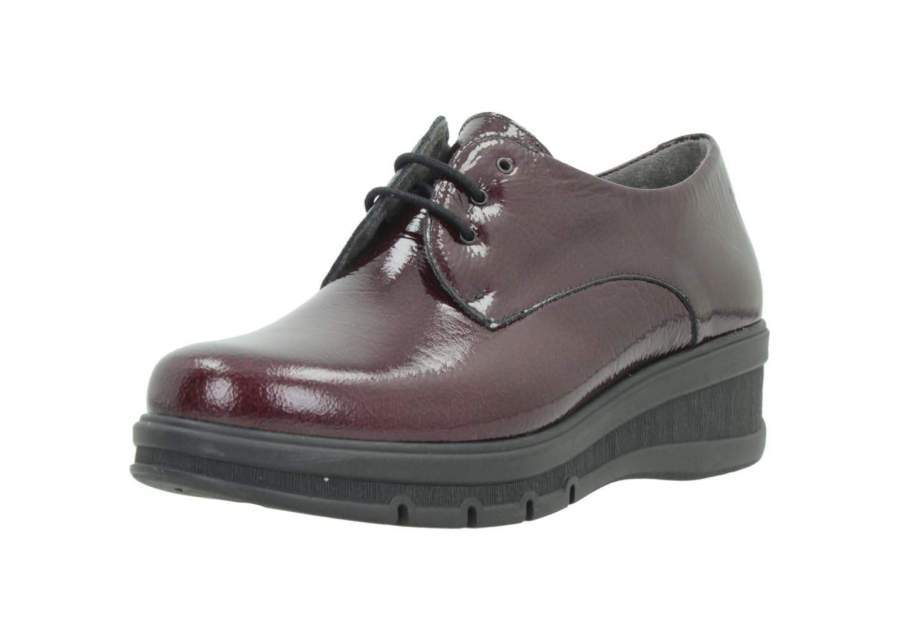
In the Lace Shoe section there are several examples with different figures. The 11091 is described as first-quality leather with the leather perforated to encourage breathability, and a broad-based sole with a slight wedge. The 11545 is patent leather in a croc finish, with textile lining, width 9 and a 3 cm sole. The 11501 combines patent and nappa leather, with the same width 9 and a slightly higher sole, 4 cm. Three lace-ups from one brand behaving in three different ways.
Velcro and elastics: when bending down is the problem
If the issue isn't the fit but the act of tying, the catalogue offers two routes. The Velcro shoe section gathers the only fastening that opens in one go and can also be adjusted: the 10772, in croc-finish patent leather, pairs it with a 3 cm non-slip sole; the 11504 sets it on patterned patent leather with a 4 cm sole; and the 10721, made with lycra and leathers described as soft and gentle, puts the velcro across the instep precisely to make getting in easier.
The other route is elastic. In Moccasins, the 10700 is a croc-finish patent leather moccasin with textile lining, width 9 and a 4 cm sole that you slip on in one movement. The practical difference between the two systems is simple:
- Velcro: quick and adjustable. It wins when the volume of your foot changes through the day.
- Elastics: easiest to put on, but the fit is the one it left the factory with.
- Laces: the most precise. They win when you walk a lot or use your own insole.
Court shoes and ankle boots: dressy without giving up width
The brand also covers dressier footwear without changing its criteria. In Salons, the 10820 runs an elastic right around the perimeter to help the fit, and keeps a removable insole and width 9 even as the sole rises to 5 cm. In Booty Shoe, the 11624 is described as croc-finish patent combined with smooth leather, on a 4 cm sole, and its own page says it aims for a current look "while always respecting good fit and good materials". The brand is in Merceditas too, with the same underlying idea.
It's a detail worth noting: in a lot of dressy footwear, width and insole are the first things sacrificed, and here they are still there.
If you use your own insoles
This is more common than it seems and causes a fair number of avoidable returns. Since almost all of these models have a removable insole, you can take it out and fit yours. But check page by page, because swapping it lifts the foot a few millimetres and the instep can end up tight — especially in moccasins and court shoes, where there is nothing to loosen.
If that's your plan, the shop has a clear starting point in Shoes for insoles, and the practical rule is the usual one: with your own insole, laces or velcro are almost always a better idea than elastic.
Who they fit and who they don't
They fit well if you need a wide last and want to know how wide before you buy, if you change the insole, or if you spend the day stepping in and out of your shoes. They fit less well if you're after technical long-distance walking footwear or a heavily cushioned sole: these pages talk about a good base, flexibility and grip, not cushioning.
An honest note
Breathability, sole flexibility and last width are characteristics of the material and the construction, not medical treatments. A well-chosen shoe can make a day on your feet far more bearable, but it doesn't correct anything on its own. If you have persistent pain or a specific need, the sensible thing is to see a healthcare professional and, meanwhile, wear footwear that fits without pressing anywhere.
Conclusion
With this brand the short route is to look at two numbers on the page: the last width and the sole height. The first tells you whether the shoe will respect your foot at the sides; the second, how you'll be standing on it. Then you choose the fastening to suit your day — and the removable insole comes as standard across almost the whole catalogue.