

Dian: what characterises its professional footwear and how to choose the model
Dian covers clogs, lace-up trainers and closed shoes, and each is designed for a different shift. We go through what really separates them and how to decide based on how much you walk.
By number of models available, Dian is one of the best-represented brands in our professional footwear range. But “Dian” is not a single type of shoe: within the brand there are open clogs, lace-up trainers and closed shoes, and each is designed for a different working day. In this guide we go through what separates them and how to choose according to your shift.
Who usually looks for this footwear
Dian's footwear is aimed above all at people who spend the day on their feet indoors: healthcare, hospitality, hair salons, cleaning or delivery. Trades with three things in common: many hours in a row, smooth floors that may be wet, and the need to clean the footwear often.
That explains the design decisions that repeat across almost all their models: straight lasts with a rounded toe so the toes have room, soles described as slip-resistant, breathable materials and footbeds that come out. They are all in the Sanitary Clogs and Professional Footwear section.
The clogs: the quickest format to put on and clean
Clogs are the brand's best-known family, and within them there are two quite different constructions.
The Dian Pisa is made from perforated technical microfibre, with padding at the instep and a folding retaining strap at the heel. It has a straight last with a rounded toe and an anatomical footbed with a metatarsal bar, and the sole is wedge-shaped polyurethane, dual density, with an antibacterial and slip-resistant finish. Of the two it is the clog with more body: it holds and cushions more.
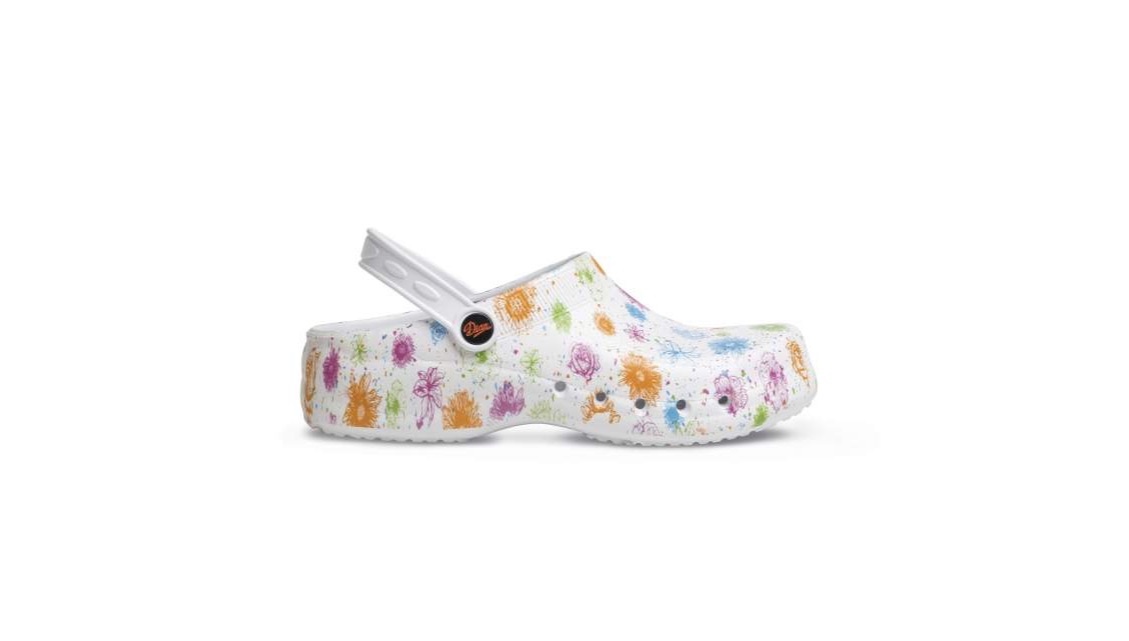
The Dian EVA goes the opposite way: a single moulded piece of EVA, ultralight, which according to the product page weighs 180 grams a pair, latex-free and machine washable up to 40 ºC. It has side perforations that help with breathability and rinsing, massage micro-dots on the footbed surface, and a folding rear strap as well. It is the option for anyone who puts weight and cleaning above everything else. Both also come in a printed version.
- If you are at a more or less fixed station and take them off several times, the clog wins.
- If you are going to walk a lot, flip the heel strap up: that is what stops the foot sliding.
- If your footwear really gets dirty, check whether it can be machine washed.
The work trainers: when you are moving all shift
When the day is all back and forth, an adjustable fastening holds better than a strap. That is where models like the Dian CALPE and the Dian MILAN - SCL come in: work trainers in breathable, liquid-repellent textile, with a slip-resistant sole, a padded removable footbed and lace fastening.
The advantage of laces is that they let you adjust the instep precisely, and that is exactly what stops the foot travelling forward as you walk. The CALPE product page expressly mentions hospitality, healthcare, hair salons and delivery work, which are the uses where this format makes most sense.
The closed shoe with a hook-and-loop strap
The third format covers the foot completely and solves the adjustment without bending down. The Dian Milán-SCL in its hook-and-loop version has a microfibre upper, a lining described as highly breathable and quick-drying, a straight last with a rounded toe and a heel counter to hold the rearfoot. The padded footbed combines textile and polyurethane foam with an antibacterial finish.
It is the sensible choice if liquids land at your station, if you step in and out of your shoes often, or if you simply find it awkward to tie laces several times a day. If you want that kind of fastening outside work too, the shop has a Velcro shoe section.
How to decide between the three
The useful question is not which model is best, but how much you walk on your shift and what lands on the shoe.
- Long periods standing at a fixed station: clog, and the lighter the better.
- Walking all shift: lace-up trainer, for the instep adjustment.
- Liquids, or stepping in and out of your shoes: closed shoe, preferably with a hook-and-loop strap.
- Two very different shifts: many people end up with two pairs, and that is a sensible decision.
Insoles, size and last
A good share of these models have a removable footbed, which makes using your own insole easier. Even so it needs checking model by model on the product page, because replacing the footbed raises the foot and the instep can end up tight. If you already use insoles, the starting points in the shop are Footwear for insoles and Shoes for insoles.
On size, these lasts are straight and round-toed on purpose, to leave the toes room over long hours. If you are coming from a narrow shoe it feels roomier, and that does not mean the size is too big. Try them with your work sock, check the heel does not lift as you walk, and walk for a few minutes looking for rubbing.
An honest note
The antibacterial finishes, breathability or cushioning described on the product pages are properties of the material, not medical treatments. If you have persistent pain or a specific need, the prudent course is to consult a healthcare professional and, in the meantime, to choose footwear that fits well and does not pinch anywhere.
Conclusion
Within Dian the real decision is the format: a clog to slip out of quickly and clean easily, a lace-up trainer for moving a lot, a closed hook-and-loop shoe to cover the foot without wrestling with laces. After that, look at the weight if your shift is long, at machine washing if it gets dirty, and at whether the footbed comes out if you use your own. With that, comparing models stops being a matter of luck.