

Sanitary clogs and professional footwear: what to check before buying
Choosing shoes for a shift on your feet is nothing like buying a pair to go out in. We go through the three formats that exist, which sole suits smooth floors and how to tell whether a model takes your own insoles.
Anyone who works a full shift on their feet does not choose footwear the way someone buys a pair to go out in. Here what matters is the floor underfoot, the hours in a row, the liquids that land on the shoe and how easily it cleans up at the end of the day. In this guide we go through what is worth checking before buying work footwear, and which format suits which shift.
Why work footwear is chosen on different criteria
Over an eight or ten hour shift the foot swells, sweats and stays far longer in the same position. Add floors that may be wet, splashes and, in many trades, the requirement to be able to clean the shoe thoroughly. That is why a model that feels comfortable on a walk can fall short across a working day.
In practice, four things matter more than the design: how the heel is held, what the sole is like, how much it weighs and how it cleans. In the shop these models are grouped under Sanitary Clogs and Professional Footwear.
- Hold: the foot should not slide forward as you walk.
- Sole: how it behaves on a smooth and possibly wet floor.
- Weight: what you don't notice in the shop you notice six hours in.
- Cleaning: whether it can be washed, and at what temperature.
The three formats and what each is for
Professional footwear comes in essentially three constructions, and the difference between them matters far more than the difference between colours.
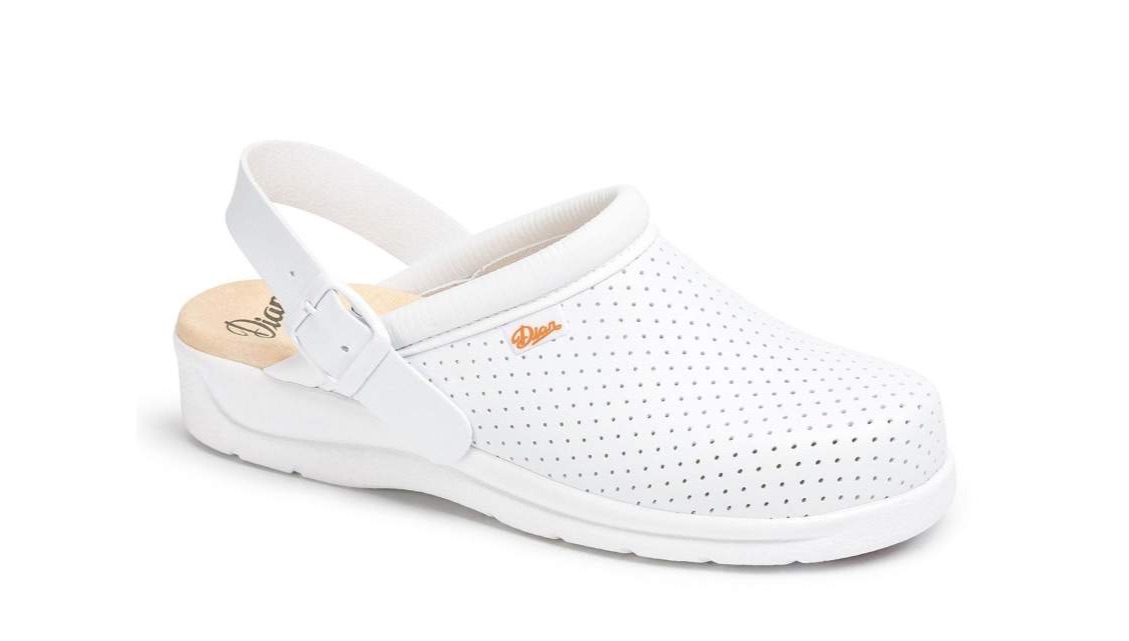
The open-backed clog is the quickest to put on and take off, and the easiest to clean. Many models have a folding heel strap: you can leave it down when you are at a fixed station and flip it up when there is walking to do. If you walk or take stairs during your shift, that strap stops being a detail and becomes the main thing.
The lace-up work trainer holds more and lets you adjust the instep, which is what actually stops the foot from moving around. It is the sensible option for anyone on the move all shift: hospitality, delivery, hair salons, large departments.
The closed shoe, laced or with a hook-and-loop strap, covers the foot most. If liquids land at your station, or there is a risk of small knocks, covering the instep matters. A hook-and-loop fastening also solves the adjustment without bending down, which is a real advantage when you step in and out of your shoes several times a day.
The sole: the detail you notice most
Indoors the enemy is not mud, it is the freshly mopped smooth floor. Look for soles expressly described as slip-resistant and, where the information is available, look at the tread: a tread with channels clears liquid better than an almost flat surface.
Cushioning counts too. Some models have a dual-density polyurethane sole, combining a softer layer against the foot with a firmer one underneath; others are single-piece EVA, far lighter. Neither is better in the abstract: polyurethane tends to give more body, EVA wins on weight.
- Check that the product page expressly mentions the slip-resistant sole.
- A slight wedge often spreads the load better than a completely flat sole.
- Check how the sole flexes where the foot bends.
Weight and cleaning matter more on a long shift than they look
Weight is the factor most often underestimated at the point of purchase. A single-piece EVA clog can stay around 180 grams a pair, while a microfibre model with a polyurethane sole weighs considerably more. Multiply that difference by thousands of steps and it becomes clear why many people end up with two pairs for different shifts.
Cleaning belongs in the same bracket. Some EVA models can go in the washing machine up to 40 ºC, and others have side perforations that help both with breathability and with rinsing them out. If your footwear really gets dirty at work, that difference decides more than the colour does.
If you use your own insoles
A model looking roomy does not mean it will take your insole. What needs checking is whether the original footbed is removable and whether enough volume remains once it is replaced, because your own insole on top of the factory one raises the foot and leaves the instep tight.
The shop has two specific sections for this, Footwear for insoles and Shoes for insoles, and they are the sensible starting point if you already use one. Either way the individual product page decides: that is where it says whether the footbed comes out.
Size and last
In work footwear the last matters as much as the size. Many professional lasts are straight and finish in a rounded toe, precisely so the toes have room over long hours. If you are coming from a narrow-lasted shoe, it feels different at first, and that does not mean the size is too big.
- Try them with the sock you wear at work, not a thin one.
- Leave room in front of the toes, but the heel should not lift as you walk.
- If the model has a strap or hook-and-loop fastening, adjust it before judging the fit.
- Walk for a few minutes looking for rubbing: on a long shift, a small rub becomes a blister.
An honest note
This footwear is designed for standing for long periods and for cleaning easily, not for treating anything. If you have discomfort that will not go away, persistent pain or a specific need, the sensible thing is to consult a healthcare professional and, in the meantime, to prioritise footwear that fits well and does not pinch.
Conclusion
To get work footwear right, decide the format first, according to how much you walk on your shift: a clog if you are at a fixed station and need to slip out of it quickly, a lace-up trainer if you are on the move all shift, a closed shoe if liquids land on you. Then look at sole, weight and cleaning, and check on the product page whether the footbed is removable. With those four pieces of information the choice stops being a gamble.